
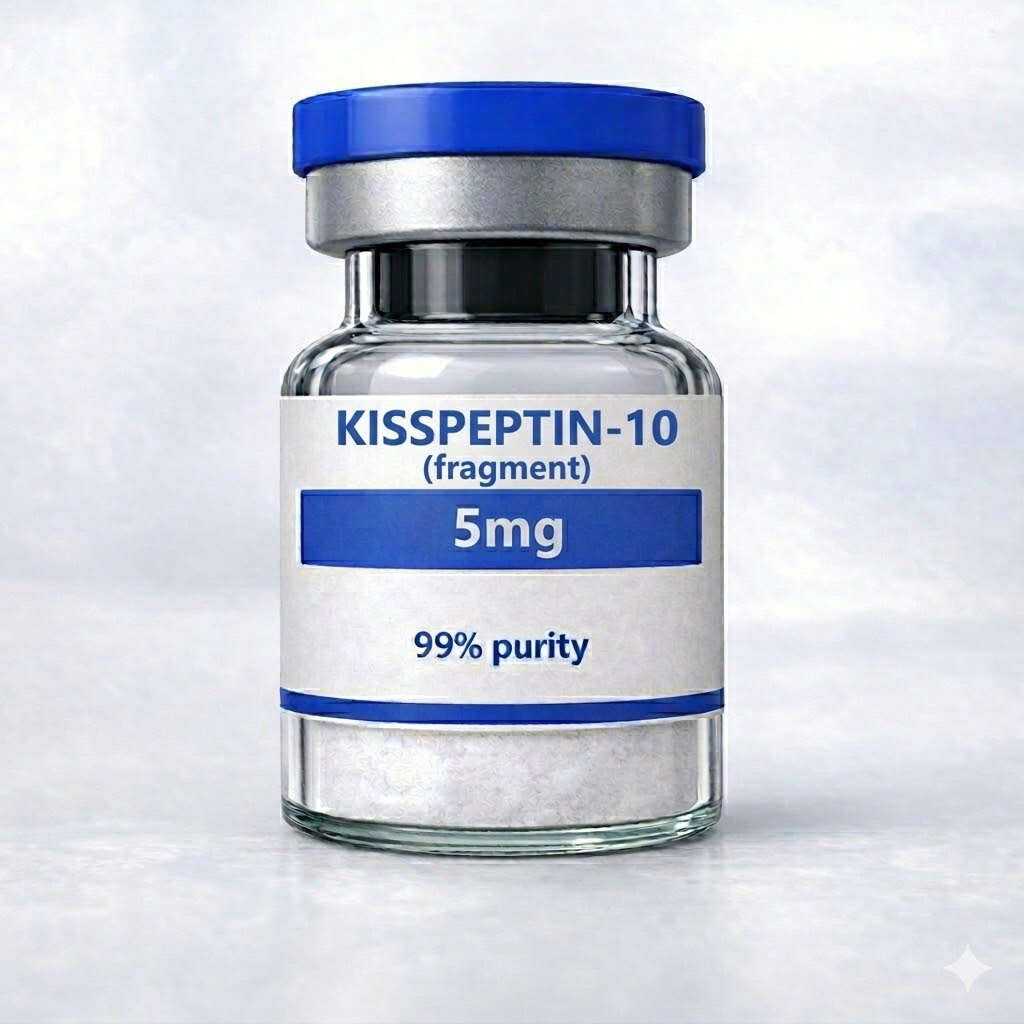
KISSPEPTIN-10
Peptide therapies have moved from obscure academic journals into mainstream health conversations. In particular, kisspeptin-10 has begun appearing in discussions around fertility medicine, testosterone optimisation, and metabolic hormone regulation.
Yet as with many peptides that gain sudden attention, the conversation online often outpaces the science.
Some describe kisspeptin as a breakthrough for testosterone optimisation. Others frame it as a fertility-enhancing peptide capable of restoring hormonal balance. The reality, as is often the case in endocrinology, is more nuanced.
Kisspeptin is not a testosterone drug. It is not a shortcut to hormonal optimisation. Instead, it is part of a critical signaling system at the top of the reproductive hormone cascade, helping the brain determine when the body is ready for reproduction.
Understanding kisspeptin requires stepping back and looking at how the body regulates hormones in the first place.
This article examines what current research actually shows about kisspeptin-10, where the science is most promising, and how it fits within the broader landscape of hormone optimisation and metabolic health.
The Biology of Kisspeptin: A Master Regulator of Reproductive Hormones
Modern reproductive endocrinology recognizes the kisspeptin system as one of the most important regulators of the reproductive axis.
The system centers around the KISS1 gene, which produces peptides collectively known as kisspeptins. These peptides bind to the GPR54 receptor (also called KISS1R) located primarily on neurons within the hypothalamus.
While the discovery initially emerged from cancer biology research in the 1990s, it soon became clear that kisspeptin played a central role in the activation of reproductive hormones.
Genetic studies revealed a striking pattern: individuals with mutations affecting the kisspeptin receptor often experienced hypogonadotropic hypogonadism, a condition where the brain fails to stimulate reproductive hormone production.
In contrast, excessive activation of this pathway was linked to precocious puberty.
These discoveries established kisspeptin as one of the key switches controlling the hypothalamic-pituitary-gonadal (HPG) axis.
How the Brain Controls Hormones
To understand kisspeptin, it helps to review the basic hormonal cascade involved in reproductive health.
The system begins in the hypothalamus, a small but powerful region of the brain responsible for coordinating endocrine signals.
The sequence generally follows this pathway:
Hypothalamus → Gonadotropin-Releasing Hormone (GnRH)
Pituitary → Luteinizing Hormone (LH) and Follicle-Stimulating Hormone (FSH)
Gonads → Testosterone, estrogen, and gamete production
Kisspeptin operates at the very top of this cascade.
Specialized neurons in the hypothalamus release kisspeptin, which then stimulates nearby neurons responsible for releasing GnRH. Once GnRH is released, the downstream hormonal events follow.
In practical terms, kisspeptin acts as a biological gatekeeper. It helps determine when the body should activate reproductive signaling.
Be the first to review “KISSPEPTIN-10 (fragment)”
Related products


PEPTIDES
PEPTIDES
PEPTIDES


PEPTIDES

PEPTIDES
PEPTIDES

PEPTIDES

PEPTIDES
Reviews
There are no reviews yet.