

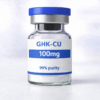
GHK-CU
GHK (glycyl-L-histidyl-L-lysine) is a naturally occurring peptide found in human serum with levels averaging 200 ng/ml at age 20 but declining to an average of 80 ng/ml by age 60. The molecule has a very high affinity for copper and forms the chelate GHK-Cu. The peptide as well as its Cu (II) chelate have anti-inflammatory and tissue remodeling properties. GHK-Cu has been shown to promote skin remodeling, wound healing and regeneration, and has prominent antioxidant and anti-inflammatory effects in in vitro and in vivo studies. In addition, preliminary observations suggest GHK can partially reverse cognitive impairment in aging mice by targeting anti-inflammatory and epigenetic pathways. The evidence as presented provides the rationale to further investigate this naturally occurring peptide in preclinical and clinical aging studies.
What is GHK?
GHK (glycyl-L-histidyl-L-lysine) is a naturally occurring peptide originally found in human serum and shown to stimulate growth in hepatoma cells [1]. The molecule has a very high affinity for copper (II) and forms the chelate GHK-Cu. The plasma level of GHK is about 200 ng/ml at age 20 but declines to 80 ng/ml by age 60. However, no studies have yet been reported linking low serum GHK levels with specific aging processes or age-related disease. The peptide is cleaved and released from its parent protein SPARC during the degradation of extracellular matrix, to aid in tissue remodeling by increasing levels of angiogenesis [2]. Both GHK and GHK-Cu have been shown to have anti-inflammatory and tissue remodeling properties. GHK-Cu has been studied in clinical research showing positive effects on skin remodeling and regeneration.
The tissue remodeling effect of GHK
GHK-Cu has been extensively studied for its tissue remodeling and wound healing abilities for nearly four decades [3]. GHK-Cu at a concentration of 1nM increases the expression of basic fibroblast growth factor (bFGF) and vascular endothelial growth factor (VEGF) in irradiated human dermal fibroblasts, both of which aid blood vessel formation and blood flow into damaged tissues [4–6]. It also increases HUVECs proliferation by stimulating VEGF and FGF-2 expressions, promoting angiogenesis that aids in wound healing [7]. GHK-Cu at low concentrations is a powerful attractant for capillary cells that build new blood vessels, and a powerful migration stimulant for macrophages and mast cells that remove damaged cellular debris and secrete proteins important for wound contraction and tissue healing [8–9]. Since copper is an important trace element that plays a key factor in the production of collagen and elastin, GHK-Cu can be a natural supplement for copper in the connective tissue synthesis [10–11]. It is also involved in the activation of the synthesis of matrix compounds in vivo, which are critical for the formation of a resistant new tissue [12–13].
Moreover, GHK-Cu promotes bone healing and enhances osteoblastic cell attachment, potentially through the increase in collagen synthesis [14–15]. Articular injection of 0.3 mg/ml GHK-Cu enhances some of the healing outcomes in a rat model of anterior cruciate ligament reconstruction (ACLR), and the treatment of GHK-Cu encapsulated in liposome significantly fasten burn wound healing in mice with scald wound [7, 16]. In addition to wound healing studies in mice, clinical studies have been done on the effect of GHK-Cu on skin regeneration, which show a more rapid healing process and better skin conditions with GHK-Cu in the skin cream [3, 17].
The anti-inflammatory effect of GHK
Both GHK and its copper (II) complex GHK-Cu have been studied for antioxidant and anti-inflammatory activities. Without being bound to copper, GHK has been shown to be a quencher of cytotoxic end products of lipid peroxidation such as α,β−4-hydroxy-trans-2-nonenal and acrolein, which can be associated with severe pathologies such as diabetes and neurodegenerative disease [18–19]. With a concentration as low as 10uM, the addition of GHK can reduce the tert-butyl hydroperoxide-induced reactive oxygen species (ROS) level in Caco-2 cells by almost 50-percent. Moreover, GHK has been shown to be a quencher for hydroxyl and peroxyl radicals by ESR spectroscopy, with its ability to quench hydroxyl radicals much stronger than glutathione (GSH), making it a strong endogenous antioxidant [20]. In a bleomycin-induced fibrosis mouse model, treatment with GHK showed reduced inflammatory cell infiltration and interstitial thickness with reduced TNF-α and IL-6 expression, suggesting GHK as a potential treatment for pulmonary fibrosis [21]. Compared with GHK, its copper (II)-chelated form shows a more prominent antioxidant and anti-inflammatory effect in both in vitro and in vivo studies. Pretreatment of RAW 264.7 macrophage cells with GHK-Cu has been shown to significantly decrease ROS levels induced by lipopolysaccharide (LPS), increase levels of SOD activities and total GSH, and decrease levels of TNF-α and IL-6 production through the suppression of NF-κB p65 and p38 MAPK signaling [22]. Both signaling pathways are key regulators of inflammation and pro-inflammatory responses, which are considered targets for developing anti-inflammatory therapeutic agents [23–26]. In the LPS-induced acute lung injury mouse model, treatment of GHK-Cu also significantly suppressed TNF-α and IL-6 expression with a significant decrease of both NF-κB p65 and p38 MAPK signaling, suggesting that GHK-Cu is useful for the development of novel anti-inflammatory therapies [22]. We have also found that pretreatment of GHK-Cu has a robust antioxidant effect in WI-38 cells treated with 150uM of hydrogen peroxide, decreasing the ROS level to almost 60 percent
Be the first to review “GHK-CU (CU50)”
Related products

PEPTIDES
PEPTIDES


PEPTIDES

PEPTIDES
PEPTIDES

PEPTIDES

PEPTIDES
PEPTIDES
Reviews
There are no reviews yet.