
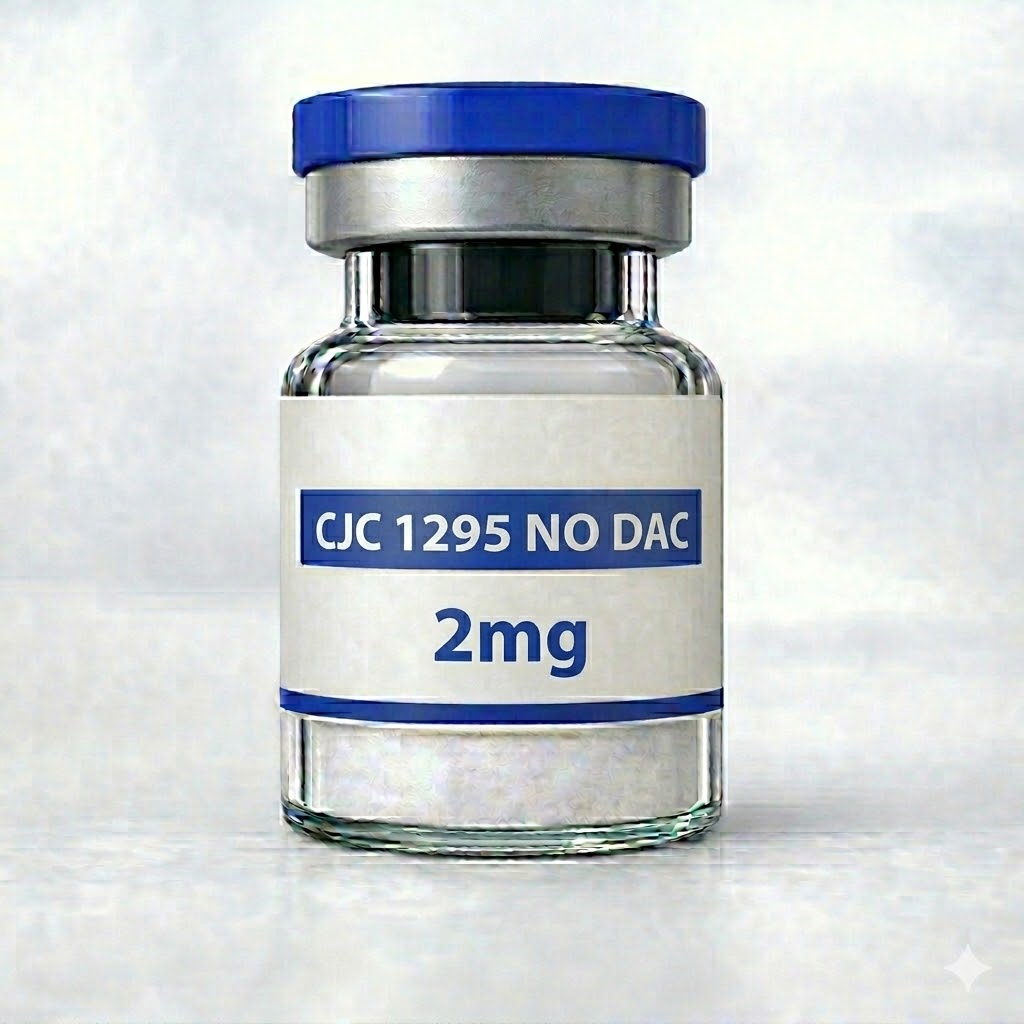
CJC 1295 NO DAC
What is the difference between CJC-1295 and CJC-1295 with DAC?
are both peptides that are used for their potential to increase growth hormone levels, but they differ significantly in their structure and duration of action due to the addition of DAC (Drug Affinity Complex). Here’s a detailed comparison:
Structure: CJC-1295 without DAC is a modified form of GRF (1-29), also known as Sermorelin. It has been modified to enhance its stability and half-life compared to the original GRF (1-29). CJC-1295 with DAC includes the Drug Affinity Complex (DAC), which is a modification that extends the peptide’s half-life significantly.
Half-Life: CJC-1295 without DAC has a relatively short half-life, typically around 30 minutes to an hour. This requires frequent dosing, often multiple times per day, to maintain elevated growth hormone levels. The addition of DAC increases the half-life of CJC-1295 to about 8 days, meaning that it remains active in the body for a much longer period. This reduces the frequency of injections needed, often to once or twice per week.
Mechanism of Action: CJC-1295 without DAC acts by stimulating the release of growth hormone from the pituitary gland in a pulsatile manner, mimicking the natural release patterns of growth hormone. CJC-1295 with DAC also stimulates the release of growth hormone but does so in a more sustained manner due to its extended half-life. This results in more consistent levels of growth hormone over a longer period.
| CAS | Name | Description |
| 86168-78-7 | Sermorelin | Sermorelin is a synthetic peptide analogue of growth hormone-releasing hormone (GHRH), a naturally occurring hormone that stimulates the production and release of growth hormone by the pituitary gland. |
| CJC-1295 acetate | CJC-1295 acetate, on the other hand, is a modified form of CJC-1295 with a longer half-life. The acetate modification increases the stability of the peptide in the body, prolonging its effects. This allows for less frequent dosing compared to CJC-1295 without DAC. | |
| 170851-70-4 | ipamorelin | It is a synthetic peptide that acts as a selective agonist of the growth hormone secretagogue receptor, stimulating the release of growth hormone from the pituitary gland. |
| Ipamorelin diacetate | It is a synthetic peptide known for its ability to stimulate the release of growth hormone by binding to the ghrelin receptor. It’s often used in research settings to study growth hormone secretion and its effects on various physiological processes, such as muscle growth, metabolism, and bone density. |
Synthesis route of CJC1295 Without DAC
Solid-phase peptide synthesis (SPPS): The synthesis typically begins with SPPS, a method widely used to produce peptides. In this process, the peptide chain is built step-by-step on a solid support, usually a resin.
Protection of Functional Groups: During SPPS, various functional groups of the amino acids must be protected to ensure selective reactions. For instance, the N-terminus and side chains of certain amino acids might require temporary protection.
Coupling Reactions: Amino acids are sequentially added to the growing peptide chain. Each addition involves coupling the protected amino acid to the growing peptide chain using coupling reagents such as DIC (diisopropylcarbodiimide) or HBTU (2-(1H-benzotriazol-1-yl)-1,1,3,3-tetramethyluronium hexafluorophosphate).
Removal of Protecting Groups: After each coupling step, the protecting groups are removed to expose reactive functional groups for the next coupling reaction.
De-protection and Cleavage: Once the desired peptide sequence is assembled on the solid support, the peptide is cleaved from the resin and deprotected simultaneously. Commonly used cleavage reagents include trifluoroacetic acid (TFA) along with scavengers like triisopropylsilane (TIS) to prevent side reactions.
Purification and Characterization: The crude peptide is then purified using techniques such as reverse-phase high-performance liquid chromatography (RP-HPLC) to isolate the desired product from impurities. The purified peptide is characterized using analytical techniques like mass spectrometry and high-performance liquid chromatography to confirm its identity and purity.
Lyophilization: Finally, the purified peptide is typically lyophilized (freeze-dried) to obtain a stable solid form that can be stored for long periods.
Be the first to review “CJC 1295 NO DAC”
Related products
PEPTIDES


PEPTIDES

PEPTIDES


PEPTIDES


PEPTIDES
PEPTIDES

PEPTIDES

PEPTIDES
Reviews
There are no reviews yet.